Why a “Verified” Caller ID Is No Longer Enough
By ICA AI Staff · October 2026
“Verified” Is Not the Same as Trusted
The phone call has a trust problem. Your phone rings, the screen flashes a reassuring “Verified” badge or a green checkmark, and you answer, only to find a scammer on the other end. Despite years of investment in the STIR/SHAKEN security framework, reported U.S. fraud losses across all channels reached a record of about $16 billion in 2025, according to the FTC. The tools designed to restore our confidence fall short because they were built to solve for identity, not for trust.
For most of human history, trust was a slow-growth asset. You knew a voice because you had heard its cadence a thousand times; you trusted a merchant because your family had traded with theirs for generations. Modern telecommunications has attempted to replace this rich, historical context with a technical substitute: the identity stamp. We have swapped the fundamental human question — “Should I trust this interaction?” — for a narrow technical one: “Is this identity verified?” This substitution is a systemic mistake. A verified identity is a useful tool, but it is a dangerously insufficient basis for trust.
1. Identity Is Frozen, but Relationships Learn
In digital communications, there is a chasm between a “Cold Start” and a “Mature Relationship.” When a pharmacy you’ve never used calls for the first time, a technical authentication signal is your only signal. It’s a useful starting point, providing evidence where there would otherwise be none. However, as a relationship matures, that technical badge should become the least interesting thing about the call.
The problem is that identity is a “frozen” credential; it says the same thing on the first call as it does on the thousandth. Relationships, by contrast, “learn.” They are built on a reciprocal record, representing the shared history of timing, cadence, and specific knowledge held by both parties. As history accumulates, the technical stamp carries less of the weight.
Identity is a point-check, a “who are you?” query at the gate. Trust is a historical, reciprocal state. If we rely on the badge alone, we ignore the fact that trust is an outgrowth of behavior over time, not a stamp granted by a provider.
2. What the Green Checkmark Actually Certifies
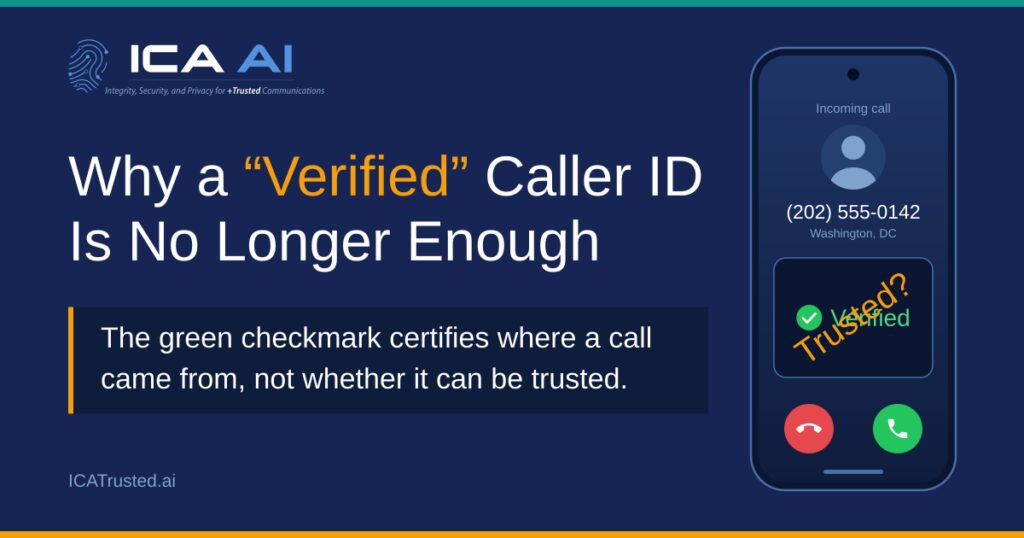
The uncomfortable reality of modern phone security is that the “Green Checkmark” does not certify the integrity of a call; it only certifies its origin. In June 2026, 97.4% of calls signed by the ten most prolific robocall-signing providers carried “A-level” attestation, which is the highest grade the framework issues.
Scammers routinely hold the top credential because originating providers are incentivized to “attest generously.” These providers are paid on the volume of calls they carry, not on the honesty of those calls. The result is a dangerous “Arthur Andersen effect,” named for the auditing firm that collapsed in 2002. Andersen’s certifications were present and authoritative, but they were wrong. Like those audits, a confident, valid-looking “Verified” signal is more dangerous than no signal at all when it is wrong, because it shuts down our natural skepticism. When the system flashes a green light, we stop looking for the red flags.
3. The 50% Leak: Security That Evaporates in Transit
Even if a call is perfectly authenticated at its source, a coverage gap remains. For a digital signature to survive, it must travel across an entirely IP-based path. But the global phone network is a patchwork of legacy TDM systems and modern IP networks.
When a call crosses an older, non-IP (TDM) segment — a legacy interconnect, say, or an international gateway — the security headers are simply stripped away. This is the “Broken Telephone” of digital security. In June 2026, only 48.8% of calls arrived at their destination with a signature intact, and TransNexus, which tracks the figure, attributes the shortfall to non-IP segments like these. A security signal missing from more than half of calls when they arrive cannot be the basis of a trust system.
4. The “Compromised Account” Loophole That Identity Can’t Close
Identity-based security has a blind spot: the account takeover. Imagine your actual bank calls you from its actual number. The identity is verified, the badge is active, and the credentials are 100% authentic. But the person on the other end is a fraudster who has hijacked the line.
In this scenario, a system that only checks identity will fail every time. The identity is “right,” but the behavior is “wrong.”
“Identity verified, trust misplaced. If verifying identity were the same as establishing trust, that situation could not exist. It exists routinely.”
5. The Speed of Fraud vs. the Snail’s Pace of Law
There is a fundamental mismatch between the seconds it takes to place a scam call and the decades spent trying to stop them. The FCC has recently flexed its muscles, removing thousands of providers from the Robocall Mitigation Database. However, a crucial distinction remains: those removals were mostly for deficient paperwork, not the slow, case-by-case adjudication of live fraud, where due process (detection, investigation, notice, and appeal) comes before any sanction lands.
Current records show an 18-month gap between a provider missing a compliance deadline and their eventual disconnection. Scammers treat this “Enforcement Lag” as a business model. They spin up an entity, run their calls during the months-long investigation and appeal process, and disappear before the sanction lands. This makes the regulator a “Referee in the Replay Booth,” as they can tell you the goal was illegal long after the game is over, but they are powerless to stop the play while you are holding the ringing phone.
Conclusion: Moving From Badges to Relationships
The path forward requires us to stop treating the badge as enough and start understanding the relationship. We must move toward systems that weigh the context of an interaction rather than just the validity of a credential.
ICA AI’s Trust in Communications series puts it as a test: remove a layer and see whether the structure still stands. Remove the “Verified” badge from a call with your sister, and you still trust her because of the history and reciprocity you share.
If we remove the badge and the trust remains, was the badge ever the thing we were trusting? To protect the future of voice, we must look beyond the badge.
About ICA AI, Inc.
ICA AI, Inc. is a deterministic AI infrastructure company headquartered in Boca Raton, Florida. Founded in 2018 by Ray Sheppard, the company develops +Trusted Infrastructure for AI-era personal communications — productized as the +Trusted Communication Assistant for mobile operators, MVNOs, UCaaS, and CPaaS providers. The platform decides every communication deterministically before it reaches the device, at near-zero marginal cost for decisions that resolve without speech recognition. ICA AI holds a patent portfolio of 23 filings — 15 issued, 2 allowed, and 6 pending or published — plus additional dockets in development, spanning four active patent families. Its AI-era priority footprint begins in August 2018 and extends through November 2023. The portfolio covers Relationship Fingerprints derived from raw interaction data, and the TrustScores they generate for validating communication authenticity against impersonation, spoofing, and AI-era fraud. ICA AI’s mission: Integrity, Security, and Privacy for +Trusted Communications. Learn more at www.ICATrusted.ai.