08 Trust in Communications, Paper 7: The Compromised Account

When a Real Account Is Taken Over and the Credential Is Genuine
TRUST IN COMMUNICATIONS · PAPER 7 OF 7 · ICA AI, Inc. · +Trusted Infrastructure · July 2026
A +Trusted Infrastructure series from ICA AI
Series editor: John Perkins, Chief Executive Officer
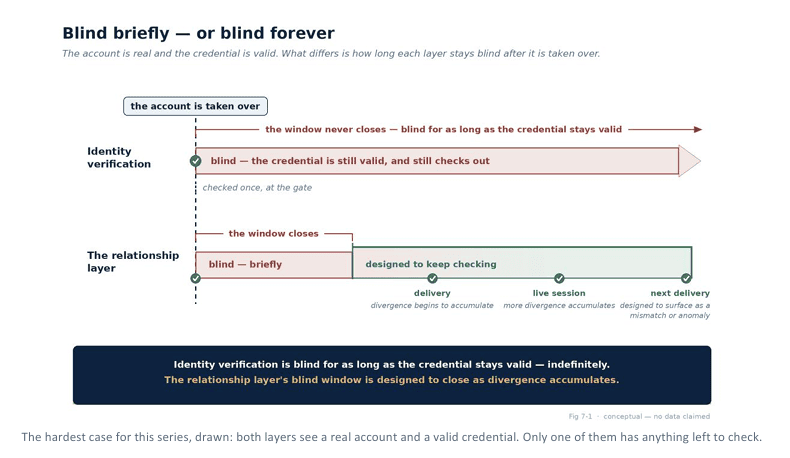
Every trust approach has a weakest edge; this paper is about the relationship approach. When a real account is taken over, there is an opening window in which the compromise has not yet shown itself — and the relationship layer does not claim to close that window instantly. The case is a comparison: identity is blind to account compromise for as long as the credential stays valid, which is indefinitely; the relationship layer is blind only until behavior diverges enough to surface, and it is designed to keep watching. A one-time gate versus a continuous check.
The stolen account: the attack that passes every check
Take the case that is genuinely hard for any behavioral approach: a real, established account is compromised, and the attacker operates it using entirely valid credentials. Every identity check passes, because nothing about the identity is fake — the account is real, the credential is real, and only the party behind it has changed. Paper 3 used this case to prove the relationship layer can
render a decision alone; this paper stays with it, because it is also where the relationship approach is tested hardest. And for some interval after the takeover, the attacker’s behavior may not yet have diverged far enough from the established pattern to raise a flag. That interval is the opening window, and this paper is not going to pretend it does not exist or that a clever enough design makes it disappear. Some fraud is fast; a window of even a short duration is a real exposure. A trust system that claimed to close this window entirely would be making exactly the kind of over promise this series argues against.
What this layer does not claim
The relationship layer does not claim to detect a takeover the instant it happens, and it does not claim that continuous checking is the same as instantaneous certainty. There is a period after compromise during which a careful attacker, operating a real account and staying close to its established behavior, looks enough like the account holder to pass — that period is the window, and it is the attacker’s window of opportunity. The value of the relationship approach has to be measured against the honest alternative, not against an imaginary perfect one — and the case does not require that the window never opens. It requires that the window closes, and closes soon enough to matter. That is the comparison with the alternative, where the window never closes at all. It would be simple to claim the system detects takeovers, full stop. That claim would be false at the edges. The truthful version is longer and less impressive: the system is designed to shorten the interval in which a takeover stays invisible, and how short depends on how quickly the attacker’s behavior gives itself away.
Blind briefly versus blind forever
Here is the comparison that matters, and it is the whole paper in one contrast. Identity verification is blind to account compromise for as long as the credential remains valid — which is to say, indefinitely, because a taken-over account presents a real credential and a point-check has no mechanism to notice that the party behind it has changed. For a pure identity approach, the window never closes on its own; it closes only when something outside the system intervenes. The relationship layer is blind only briefly. Because it is designed to check behavior continuously against the established pattern rather than once at the gate, the compromise has a limited time to stay invisible: as the attacker acts, divergence from the pattern is designed to accumulate and surface as an anomaly. The difference is not fast detection versus slow detection. It is a window that closes versus a window that does not — a one-time gate that checks once and then trusts forever, against a continuous check that keeps asking whether the behavior still fits.
Checking more than once
What does continuous actually mean here? A gate checks at one moment — the credential is presented, verified, and the party is trusted from then on. A continuous check does not stop at the gate; it re-evaluates whether the communication still matches the authorized relationship context at later points, including at delivery and during a live session, rather than resting on a decision made once at the start. The credential answers a question asked at the door; the continuous check eeps asking the same question after the party is inside. The check reads the shape of the exchange, not its substance — the same metadata and math Paper 6 describes. A hijacker who sounds exactly right has matched the one thing the layer does not consult. This is why a valid credential never confers standing trust here: the check that mattered at the door is not the only check, and a party that passed the door but then acts outside the established pattern is designed to surface as an anomaly at one of the later points rather than to ride the entry decision indefinitely. None of this makes the surfacing instantaneous. It makes the checking ongoing, which is precisely the property a one-time gate structurally lacks — not faster checking, but checking that does not stop.
Why divergence accumulates
Why does the window close at all? The whole comparison rests on the answer. A hijacker running a fraud operation cannot both use a real account and stay perfectly inside its established behavior indefinitely, for a simple reason: staying perfectly inside the established behavior earns them nothing. An attacker who wants only to watch — espionage, surveillance — is a different problem, and not the one this series is about; fraud has to act. To profit from the compromise, they eventually have to do something the real relationship would not — reach a party it would not reach, at a time it would not, in a shape the relationship has never taken. The everyday version is familiar to anyone with a phone: the taken-over account that suddenly blasts a message to everyone in the contact list. The real account holder never messaged four hundred people at once, and never at that hour. To the counterparties who each hold their own history with that account, the blast is not one anomaly — it is four hundred divergences at the same moment, one in every record it touched. That deviation is the entire point of the takeover; a compromise that never deviates from normal behavior extracts no value. And the response is itself evidence: what each counterparty does with a divergent contact — block, screen, or trust — becomes the next entry in the record the attacker would have had to predict. And each deviation is a divergence from the pattern the counterparties hold. A continuous check is designed to weigh each such divergence rather than wave it through on the strength of a valid credential. A one-time gate cannot do this at all: once it has checked the credential, it has nothing left to check, and the account is trusted for as long as the credential lasts. A continuous check has the rest of the relationship’s life to notice that something has changed — and the attacker’s need to act is what gives it something to notice.
Where the value is, and where it is not
This protection is not uniform — where it helps most depends on the speed of the attack. Against an instantaneous drain — where value moves in the first moments after takeover, before any behavior has had a chance to diverge — a continuous check has the least time to work, and this paper does not pretend it closes that case cleanly. Against slower relational fraud — where the attacker must build toward the payoff over multiple interactions, each an opportunity to diverge — the continuous check earns far more of its value, because the attack gives it time and material to surface the anomaly. The honest scope, then, is not that the relationship layer solves account takeover. It is that it converts a permanent blindness into a closing window, and that the window closes fastest exactly where the attacker is forced to act over time. The benefit is real. So are its limits.
Honesty is the point
The window is real, and anyone who works in this domain knows it. The relationship approach does not close the window the moment it opens. It is designed to make the window short and closing rather than permanent and open — and that is the whole of the claim. What the divergence is surfaced from is not a mystery: the shape of the exchange, weighed against the record the counterparty holds. What a system then does with that signal — the thresholds, the response — is implementation, and the comparison does not depend on it: one approach checks once and stops; the other keeps checking.
That contrast is where this series ends, because it is the choice the industry now faces. Seven papers have asked one question — whether verifying identity is enough to establish trust — and the answer, tested from every direction this series could find, is that it is not. Trust lives in the relationship. The infrastructure that reads it is the next layer to build.
About this series
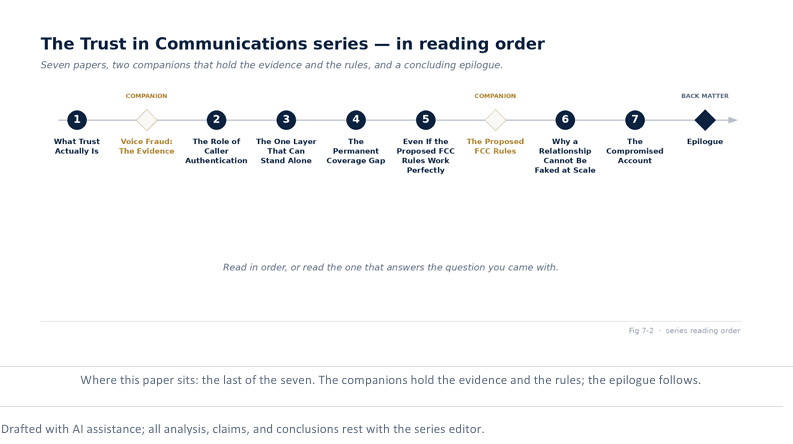
Trust in Communications is a seven-part white-paper series, with two companion volumes and a concluding epilogue, examining one question: whether verifying identity is enough to establish trust in voice communications. The list below is in reading order — the companions sit where they are best read, not at the end.
- What Trust Actually Is
◇ Companion — Voice Fraud: The Evidence - The Role of Caller Authentication in Establishing Trust
- The One Layer That Can Stand Alone
- The Permanent Coverage Gap
- Even If the Proposed FCC Rules Work Perfectly, Will They Be Enough?
◇ Companion — The Proposed FCC Rules - Why a Relationship Cannot Be Faked at Scale
- The Compromised Account (this paper)
◆ Epilogue — What Changed, What Remains True
Read the full series at ICATrusted.ai.