Why the Decision on Every Call Belongs in the Network
Call screening is moving from the handset into the network, where calling features began. The next question for carriers and service providers is what it decides from.
By John Perkins, Chief Executive Officer, ICA AI, Inc.
Vodafone, citing YouGov research, reported in December 2025 that nearly 60 percent of people miss important calls from doctors, banks and delivery firms because they do not recognize or trust an unknown mobile number. The calls that matter most are going unanswered, because people cannot tell them apart from the calls they want to avoid. Stopping bad calls is only half the job; the other half is getting the wanted ones through.
Since the smartphone arrived, the industry’s answer to unwanted calls has mostly come as applications. If you wanted a smarter way to deal with unwanted calls, you downloaded something, granted it permissions and hoped it kept pace with your phone’s operating system. That habit makes it easy to forget where calling features started.
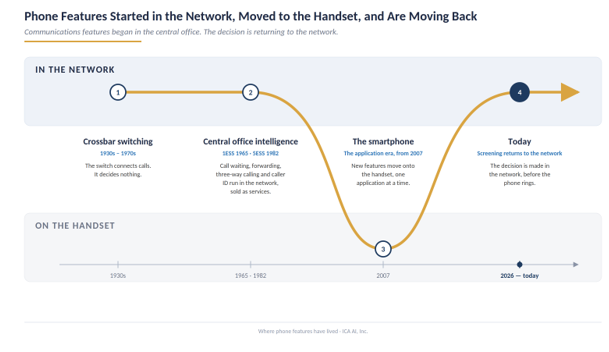
Calling features started in the network
Once carriers put computers in the central office — AT&T’s 1ESS in 1965, and the fully digital 5ESS in 1982 — the switch began to decide as well as connect. Call waiting, call forwarding, three-way calling and, later, caller ID ran there and were sold as services. They had to: the telephone had no computer of its own, so the network was the only place a feature could run. The smartphone changed that. It moved new features onto the handset, one application at a time, and for years that was where the innovation happened. Call screening followed the same path: Apple and Google now build it into the phone itself, and on the iPhone and on Pixel the phone can answer an unknown caller and ask who is calling.
Now the network is taking features back, starting with call screening. In September 2025 AT&T announced it was testing a digital receptionist built into its network, with select customers; it answers incoming calls, questions the caller and decides whether to connect, take a message or disconnect. Vodafone UK flags suspected scam calls in its network and warns customers on screen before they answer. And in June 2026 AB Handshake announced Voice Protect with Vodafone Procure & Connect, Vodafone’s wholesale arm: network screening sold to other operators. Calling features are becoming network services again.
What the network can see that the phone cannot
A phone knows who is calling it. The network knows who calls whom, across everyone it serves. That difference is the main reason call screening is moving into the network.
A phone sees one subscriber’s world: the contacts stored on it, its own call history and — if it answers on the subscriber’s behalf — what an unknown caller says. That is real information, but it is one side of every relationship, and it is all the phone has.
A network sees both parties to every call it carries, across every subscriber it serves: how often two parties communicate, how recently, who calls whom, at what hours, whether calls are returned — and how each party behaves toward everyone else.
Carriers have always held these records. For decades they read them one way: as billing. A bill is one-sided by design — the subscriber is the subject, and the other party is a line item. Read the same records as relationships, with the pair as the subject, and they answer a different question: not what to charge, but whether this call should reach this person.
Three cases where the network can do what the phone cannot
First-time callers. First contact is where fraud arrives. With no history between two parties, a phone has two choices: check a list about the number, or ask the caller. A network can see more — whether the people this caller contacts ever call back, whether the caller shares relationships with the person being called, whether the number reaches thousands of people and is never called back. Where there is too little to go on, the right answer is to screen the call, not block it. Having no information about a caller is not a bad sign.
Spoofed numbers. Screening on the phone is built for unknown numbers. Apple’s Call Screening, for example, answers calls from unknown numbers and treats a number already in the contacts as known. That makes a spoofed copy of a familiar number the easiest way past it. A caller spoofing a known contact has the number and nothing else — none of the years of calls between the real contact and the subscriber. The phone sees a familiar number and lets the call through. A system in the network is in a position to check the call against the relationship itself, and a spoofer cannot bring that history along.
Timing. A phone meets a call once it has arrived, and an unknown call still makes the person stop and judge a stranger on the spot. A good executive assistant works the other way: they take the call, find out who it is and what it is about, and interrupt only for someone the executive deals with. A system in the network can do the same before the phone rings: connect the call, stop it, or answer it, find out who is calling and why, and send the subscriber a message to decide at their own convenience.
Behind all three is scale. One phone number is one anchor. One relationship — two anchors — is one record of how two parties communicate. A network holds millions of those records and can compare them across everyone it serves. A handset that sees one subscriber’s contacts cannot assemble that picture. A network can, because the network is where the relationships are.
Being in the network is not enough
If placement were the whole story, the matter would be settled. It is not. Most screening in the network today decides from data about the number — lists, reputation scores and the carrier’s certificate on the caller ID — or from what the caller says to an AI receptionist. Numbers are recycled and spoofed, and reputation data decays. And what a caller says is exactly what an AI caller can now produce at will. Fraud used to mean faking the caller ID; increasingly it means an AI holding a convincing conversation.
Reputation has a second weakness: it is one-sided. It describes the number and says nothing about the person being called, so it points the wrong way in two cases — a good number in the wrong hands, and a caller with a poor-looking number who has dealt with this person for years. A reputation is an opinion about a number. A relationship is a fact about two people.
So the harder question is not where the decision runs, but what it decides from. The answer is the relationship between the two parties to the call — and only the network holds both sides of it.
The same holds when the caller is not a person. AI agents are starting to place calls on people’s behalf, and a convincing voice says nothing about whether anyone you deal with sent it. A decision that reads relationships asks an agent the same question it asks a person: is this a party you actually deal with? As AI grows, so does the need to trust the call.
Can an AI platform protect calls as well as the network?
AI platforms and the software that answers and routes a company’s calls sit in the path of the call too, so the question is a fair one. For this decision, they have four limits:
(1) They need the platform owner’s permission to put protection there at all, and again to change it.
(2) They are rearranged by their owners and by every customer’s own call flows.
(3) They must keep changing, because the models underneath them keep changing.
(4) No number of them adds up to a standard; each integration starts over.
They also act once a call has reached the business, and that is their job: deciding what happens to a call after it arrives. Whether a call should reach a person at all is a different question, and it comes first. Answered in the network, the same way on every network, it comes before any platform’s flow begins instead of competing with it.
What it takes to deploy in the network
Putting protection in the network takes longer than releasing an application, because it runs through the operator’s release process, security review and change windows. The decision itself is not slower — it is made before the phone rings. What a network can see also depends on the deployment: a carrier sees both ends of the calls across its network, while a provider whose numbers sit on someone else’s network sees its own numbers’ records.
The question for carriers and service providers
Call screening is going back into the network, where calling features began. For carriers and service providers, that settles where protection runs. The question it leaves is what that protection decides from: the number, the caller’s words, or the relationship between the two people on the call. Only the third is something the operator already holds, and it is expensive to fabricate and does not scale for an attacker.
That is the question ICA AI set out to answer. We build +Trusted (pronounced “plus-trusted”) Infrastructure — the foundational security and privacy infrastructure for AI-era personal communications — in the network, before the phone rings. It is designed to decide each incoming communication from the relationship between the two parties, using the metadata of the relationship — who called whom, when and for how long — not the content of the message, from records the operator already keeps. There are three outcomes: trust, screen or block. A call from someone the subscriber actually deals with is designed to go straight through — the other half of the problem in Vodafone’s figure. When a call is screened, the phone does not ring: a message arrives saying who called and why, the subscriber decides, and that choice stands as a rule for that caller. Nothing is installed on the subscriber’s phone. +Trusted is demonstrable today on an interim stack, and the commercial proof-of-concept carrier path is in progress.
Calling features began in the network because the telephone could not run them. They are returning because the network can see both sides of a call, which no phone can, and can act before the phone rings, the same way on every network. That is where the decision belongs.
About ICA AI
ICA AI, Inc. is a deterministic AI infrastructure company headquartered in Boca Raton, Florida. Founded in 2018 by Ray Sheppard, the company develops +Trusted Infrastructure for AI-era personal communications — productized as the +Trusted Communication Assistant for mobile operators, MVNOs, UCaaS, and CPaaS providers. The platform decides every communication deterministically before it reaches the device, at near-zero marginal cost for decisions that resolve without speech recognition. ICA AI holds a patent portfolio of 23 filings — 15 issued, 2 allowed, and 6 pending or published — plus additional dockets in development, spanning four active patent families. Its AI-era priority footprint begins in August 2018 and extends through November 2023. The portfolio covers Relationship Fingerprints derived from raw interaction data, and the TrustScores they generate for validating communication authenticity against impersonation, spoofing, and AI-era fraud. ICA AI’s mission: Integrity, Security, and Privacy for +Trusted Communications. Learn more at www.ICATrusted.ai.