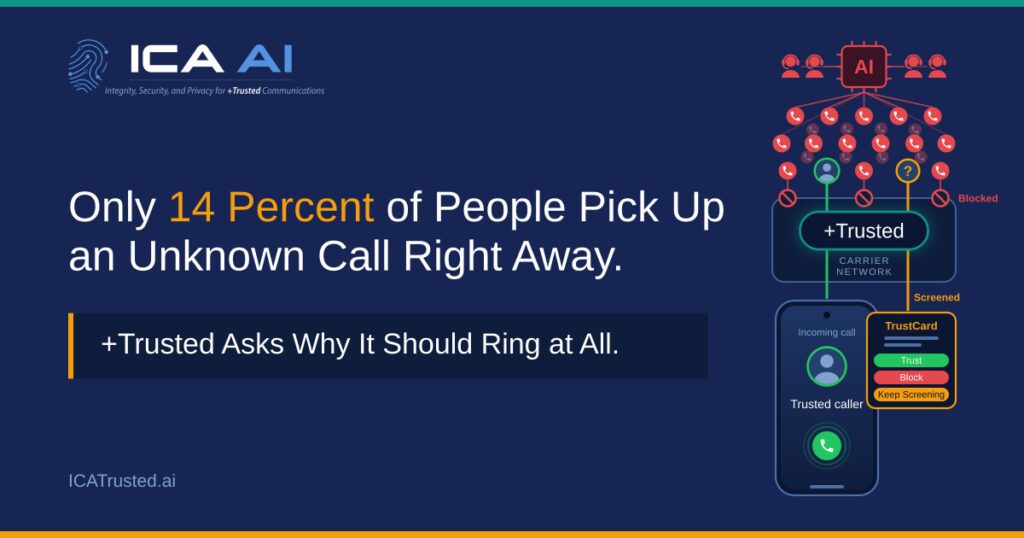
Only 14 Percent of People Pick Up an Unknown Call Right Away. +Trusted Asks Why It Should Ring at All.
A new approach to protecting the phone is designed to decide each call from the relationship between caller and subscriber, inside the carrier’s network.
By John Perkins, Chief Executive Officer, ICA AI, Inc.
For decades, phone companies have invested heavily in caller ID, number authentication, spam detection, and fraud prevention. Yet according to Hiya’s State of the Call 2026, a survey of more than 12,000 consumers in six countries, only 14 percent immediately answer a call from a number they do not recognize. We have not stopped carrying our phones. We have stopped trusting them for the one thing they were built for: talking to people we want to talk to.
One question has gone unanswered through all of it: should this particular caller reach this particular person? The cures so far have asked about the number.
AI-enriched thievery
The Federal Trade Commission’s 2025 fraud data show people reported losing $3.5 billion to imposter scams that year, through phone calls, texts, email, social media, and other channels. That is one year, and only what was reported. A grandfather sends money because a caller convinces him his granddaughter is in jail. “Tech support” posing as a well-known company takes over a computer and empties what it finds.
Now AI amplifies all of it. A phishing call no longer has to sound like a granddaughter; it can sound like her whole sorority. A robocall no longer needs a human at the controls: researchers at the University of Illinois Urbana-Champaign showed in October 2024 that AI agents can execute voice scams end to end, for an inference cost they put at under 75 cents on average per successful scam. Such a caller is infinitely patient, sounds completely normal, and can work thousands of people at the same moment.
And soon the AI on the line will not be a criminal at all. It will be somebody’s personal agent, placing calls on a perfectly legitimate number, and it will be exactly who it says it is. Number authentication stamps it and lets it through, and a thousand of them in an hour pass as easily as one. The tool was built to catch fakers. AI agents are not faking anything.
What the industry has, and what it is missing
Carriers today rely on several useful technologies. STIR/SHAKEN, which U.S. carriers run under FCC mandate, authenticates the number as presented by the caller’s own phone company, which makes spoofing harder. Reputation services flag numbers with a history of complaints or suspicious calling. The National Do Not Call Registry keeps law-abiding telemarketers away, though a criminal already breaking the law is not deterred by a list. Call blocking stops numbers already flagged, and spam labeling warns about a call that still rings.
Each of these decides something about the number: is it real, is it registered, is it on a list, has it been complained about. None of them can tell whether a particular caller has a relationship with a particular subscriber. An authenticated number can still belong to a scammer. A legitimate caller on an unfamiliar number can still be refused.
Knowing something about a number is not the same as knowing the relationship between the people on the call. That distinction is the foundation of +Trusted (pronounced “plus-trusted”) Infrastructure, which we build at ICA AI.
A different question
+Trusted asks a different question. Not “Who is this caller?” but “Do you know this caller?” Is there a relationship between the two parties, and what does it look like?
It finds the answer in records the carrier already owns, the interactions that carrier itself has carried: who called whom, when, how often, who called first, and whether the call was returned. Ten calls in twenty minutes from a number the subscriber has never called back? Probably not a friend. A number the subscriber has talked with every Sunday afternoon for three years? That one is designed to ring straight through.
That pattern is the Relationship Fingerprint, the patented behavioral signature of the accumulated relationship between two specific parties (US 12,388,880). +Trusted is designed to compute a TrustScore from it for each pair of parties, so the same caller can ring straight through to someone with years of history and be screened for someone with none. A reputation score is an opinion about a number. The history is a fact about two people; the TrustScore is what that history adds up to.
Call records, not conversations
The relationship is read from the pattern of contact: the metadata of the relationship between the parties, not the content of the message. +Trusted reads the carrier’s own records and does not license or import any third-party list.
The one conversation the system does take part in is the screening of an unknown caller. There, the Communication Assistant asks the caller who they are and what they want, and uses only what that caller chooses to say to write a short summary for the subscriber. The subscriber is not on that call.
Trust, Screen, or Block
When a call comes in, +Trusted is designed to decide before the phone rings, on a TrustScore from 0 to 100: 75 to 100 rings straight through, 50 to 74 is screened, and below 50 is blocked silently. A number whose behavior across the whole network shows the signature of a robocaller, calling strangers by the thousand, rarely called back, blocked by subscriber after subscriber, is designed to be stopped before it reaches anyone. Volume alone does not do it; a hospital that calls many people is called back and rarely blocked, and the pattern says so.
A caller with no history with the subscriber has no score, not a low one, and is neither blocked nor rung through. The phone does not ring at all. The Communication Assistant takes the call, learns who it is and what they want, and sends the subscriber a TrustCard, a short summary by text or email. The subscriber reads it when convenient and makes one choice: Trust, Block, or Keep Screening. That choice stands as the rule for that caller until the subscriber changes it. No one is on the line pressing the subscriber to pick up, and no one has to keep a block list. The Communication Assistant does the screening; the subscriber makes the decision, once.
The same relationship rules govern AI agents: whether an agent may engage at all, and whether the human it claims to act for actually authorized it. An agent with no relationship to the subscriber is screened like any other first-time caller.
+Trusted is designed to decide every communication, calls and texts alike, from the same relationships.
Probabilistic once, deterministic forever
The subscriber decides once, and that matters more than it sounds. Many AI-based screening approaches run a fresh analysis on every call, paying for it and carrying a margin of error every time. +Trusted is probabilistic only at first contact, in the conversation with an unknown caller. The decision the subscriber makes then is applied by fixed rules every time afterward. A relationship that changes is designed to be read again, and the subscriber can change a rule at any time.
First contact is a guess; every contact after is a rule. Decisions that resolve without speech recognition come at near-zero marginal cost, and the architecture is designed to need less fresh analysis as the library of settled relationships grows. For a carrier facing rising traffic and the arrival of AI agents, that is not a small difference.
Why this belongs in the network
+Trusted is not an app you install. It is designed to deploy in a carrier’s own network, where it sees both the caller and the called party on every call the carrier carries and can act before the phone rings. The records it reads are the carrier’s own and already in its possession, so the carrier does not have to look to a third party for trust data about its own customers.
It works alongside what the carrier already has and depends on none of it. STIR/SHAKEN authenticates the number; +Trusted verifies the relationship. Where a call carries an attestation, +Trusted reads it as one input among several, and a call that borrows a familiar number for the afternoon is designed to surface as a mismatch against the relationship it claims. Reputation data, fraud systems, and the carrier’s own analytics keep doing their jobs. What +Trusted adds is the question none of them was built to answer, whether this call belongs with this subscriber, so the carrier’s existing investment produces something it could not produce alone: a phone that rings for the calls worth answering.
We are building toward a simple goal: every call that rings is one the subscriber wants. No technology reaches that on day one, and this one does not claim to. What +Trusted is designed to do is let the calls with a relationship through, screen the unfamiliar ones before they interrupt, block the ones the network has seen behaving badly, and let the subscriber’s own decisions settle the rest. That is a different thing for a phone company to be.
A fifty-year question meets the AI era
Ray Sheppard, ICA AI’s Founder & Chairman, has worked on the same questions since 1976: who is calling, what do they want, and why should I talk to you. He co-invented the Relationship Fingerprint at the heart of +Trusted. AI did not invent the idea. It made it practical at scale — reading relationships in data that had only ever been read as billing records.
+Trusted is demonstrable today on an interim stack, and the commercial proof-of-concept carrier path is in progress. Carriers and service providers can arrange a live demonstration through ICATrusted.ai.
AI is changing who, or what, can place a phone call. For fifty years, screening technology has asked who is calling. +Trusted asks the question that matters to the person being called: not “Who is this?” but “Do I know you?”
About ICA AI
ICA AI, Inc. is a deterministic AI infrastructure company headquartered in Boca Raton, Florida. Founded in 2018 by Ray Sheppard, the company develops +Trusted Infrastructure for AI-era personal communications — productized as the +Trusted Communication Assistant for mobile operators, MVNOs, UCaaS, and CPaaS providers. The platform decides every communication deterministically before it reaches the device, at near-zero marginal cost for decisions that resolve without speech recognition. ICA AI holds a patent portfolio of 23 filings — 15 issued, 2 allowed, and 6 pending or published — plus additional dockets in development, spanning four active patent families. Its AI-era priority footprint begins in August 2018 and extends through November 2023. The portfolio covers Relationship Fingerprints derived from raw interaction data, and the TrustScores they generate for validating communication authenticity against impersonation, spoofing, and AI-era fraud. ICA AI’s mission: Integrity, Security, and Privacy for +Trusted Communications. Learn more at www.ICATrusted.ai.