
01 Trust in Communications: Introduction

A Seven-Part Series on Identity, Relationships, and What It Takes to Trust a Call
SERIES INTRODUCTION · ICA AI, Inc. · +Trusted Infrastructure · July 2026
A +Trusted Infrastructure series from ICA AI
Series editor: John Perkins, Chief Executive Officer
Communication has a trust problem, and nowhere is it sharper than in voice — where the
industry’s fix, proving who is calling, answers a narrower question than the one that matters.
Identity can be faked. Relationships can’t. This series asks what establishing trust actually requires,
treats caller authentication as a useful but partial tool, and follows the question across seven short
papers and two companion volumes. This introduction explains the purpose, the through-line, and
how to read them.
Why this series exists
Trust is failing in voice faster than almost anywhere else in communications. Fraud losses keep
climbing, unwanted and spoofed calls remain routine, and the tools meant to restore confidence
have not closed the gap. The industry’s response has centered on identity — attestation, know
your-customer rules, caller authentication — all aimed at verifying the identity behind a call. That
work is real, and this series does not dismiss it. The most heavily mandated of those tools shows the
gap is not closing on its own: after five years of mandate, attestation coverage has yet to reach half
of all calls — 48.8% as of June 2026 — and the calls it does sign include, at the highest grade, the
very traffic it was meant to screen out. The Evidence companion sets out the figures. But it answers
the question who is this? when the question people actually need answered is should I trust this? —
a question that turns on the relationship behind a call, not only the identity behind it. Those are not
the same question, and the distance between them is the subject of everything that follows. Voice is
where the series begins, because that is where the failure is sharpest and most current, and where
the evidence is public, dated, and testable — which makes it the proving ground for the argument,
not its boundary. The same distinction between identity and relationship reaches text, email, and
machine-to-machine communication alike.
Why it takes seven papers
The question — is verifying identity enough to establish trust? — has several parts, and answering
it means taking them one at a time rather than asserting a conclusion and defending it. Each paper
isolates one part. The early papers establish what trust and identity actually are, and where they
diverge. The middle papers test whether identity is the thing a trust decision rests on, and whether
hardening it — through better attestation or further regulation — can ever be enough. The later
papers examine the proposed FCC rules on their best possible day, the economics that keep a
relationship from being faked at scale, and the one place where the relationship approach is tested
hardest. Read in order, they form a single argument. Read alone, each still stands.
The through-line
One sentence carries the series: caller authentication is useful, but not necessary — and not
sufficient — for trust. Useful, because knowing who is calling has real value. Not necessary, because
this series argues that trust can be established from the relationship itself — its history, context,
and reciprocity — with or without a credential. Not sufficient, because a valid credential on a
compromised account passes every identity check and still should not be trusted. Hold those three
together and a different picture of the problem emerges: identity is one input to a trust decision, not
the decision itself. The purpose of this series is not to ask readers to accept this conclusion, but to
examine whether it follows from the evidence presented in the papers that follow.
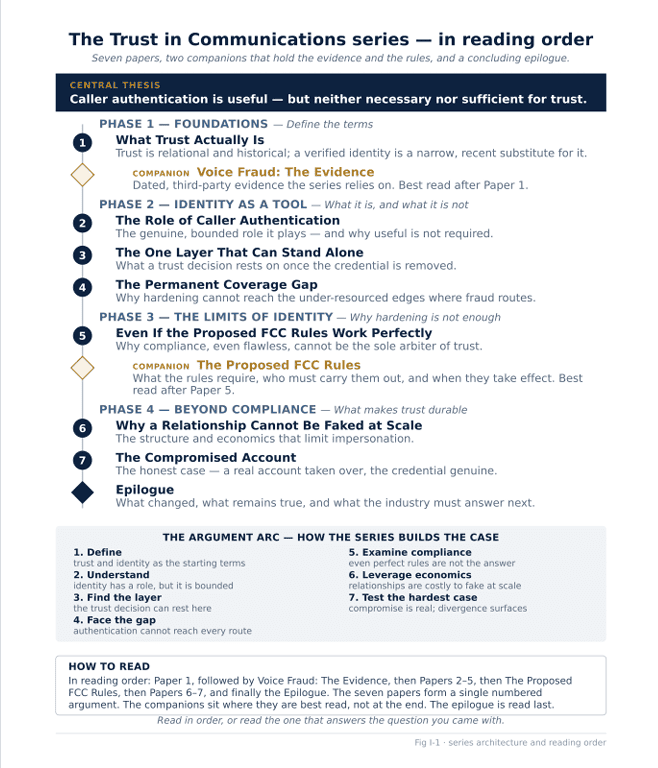
The seven papers
- What Trust Actually Is — trust is relational and historical; a verified identity is a narrow,
recent substitute for it. This paper defines the terms — a relationship as the accumulated
record of interaction both parties hold, historical, contextual, and reciprocal — and the rest of
the series builds on that definition. - The Role of Caller Authentication in Establishing Trust — the genuine, bounded role caller
authentication plays — and why “useful” is not “required.” - The One Layer That Can Stand Alone — what a trust decision actually rests on once the
credential is removed. - The Permanent Coverage Gap — why hardening authentication cannot reach the under
resourced edges where fraud routes. - Even If the Proposed FCC Rules Work Perfectly, Will They Be Enough? — why compliance,
even flawless, cannot be the sole arbiter of trust. - Why a Relationship Cannot Be Faked at Scale — the structure and economics that limit
impersonation. - The Compromised Account — the honest case — what happens when a real account is taken
over and the credential is genuine.
◆ Epilogue — What Changed, What Remains True — what the series changed, what it leaves
standing, where it stops, and the questions it hands to the field. Read last.
The two companions
Two companion volumes sit alongside the papers, each meant to be read where it does the most
work. Voice Fraud: The Evidence gathers the dated, third-party evidence the series relies on — so
the arguments rest on a common, citable base rather than re-arguing the facts each time — and is
best read early, right after Paper 1. The Proposed FCC Rules examines the regulations the industry
is treating as its answer, drawn entirely from the public record: what they require, who must carry
them out, and when they take effect. It is best read after Paper 5, where the series turns from the
coverage gap to the question of enforcement.
In reading order, then: Paper 1, followed by Voice Fraud: The Evidence, then Papers 2 through 5,
then The Proposed FCC Rules, then Papers 6 and 7, and finally the Epilogue. The seven papers remain a single numbered argument; the companions sit where they are best read, not at the end,
and the epilogue is read last.
How the series is released
The series is released in sequence rather than all at once. The Introduction, Paper 1, and Voice
Fraud: The Evidence anchor the opening — together they set the frame, make the core argument,
and put the shared evidence in the reader’s hands, which the later papers draw on. The remaining
papers follow in order, with The Proposed FCC Rules arriving alongside Paper 5, where the
argument turns to enforcement. Each piece stands on its own as it appears; read together and in
order, they form the single argument this introduction describes.
How this series is written
A word on posture. This series is written for readers who know this domain well, including those
inclined to disagree. It holds to a discipline throughout: concede what is true, claim only what can
be defended, and mark the genuinely unsettled as unsettled. It is an inquiry, not a sales sheet. It is
published by ICA AI, Inc., which is building relationship-intelligence trust infrastructure for
communications; its individual claims are meant to stand on the evidence and reasoning presented,
not on the publisher’s interest in the outcome. The fair account is the persuasive one.
Drafted with AI assistance; all analysis, claims, and conclusions rest with the series editor.
