02A Trust in Communications, Paper 1: What Trust Actually Is

Why a Verified Identity Is Not the Same as Trust
TRUST IN COMMUNICATIONS · PAPER 1 OF 7 · ICA AI, Inc. · +Trusted Infrastructure · July 2026
A +Trusted Infrastructure series from ICA AI
Series editor: John Perkins, Chief Executive Officer
Modern communications security has quietly swapped one question for another. In place of “should I trust this?” it asks “is this identity verified?” — and treats a yes to the second as a yes to the first.This paper separates them. Trust is relational: earned across time, context, and repeated interaction. Identity verification is a point-check — valuable, but narrow, and blind to almost everything trust is made of. The distinction decides whether the systems being built to protect voice communications are aimed at the right target, and it is the premise on which every paper that follows depends.
The question we stopped asking
For most of human history, trust in communication was not a technical problem. You knew a voice because you had heard it a hundred times. You extended credit to a merchant because your family had traded with his for a generation. You believed the messenger because of who vouched for him and what he had done before. Trust was something that accumulated — slowly, in context, between specific parties who carried a shared history. It was never a stamp anyone wore; it was a state that grew between people who kept showing up. Relationship has long been the primary way humans have judged trust — refined across the generations that depended on it. The identity credential, by comparison, is a recent arrival.
What made it necessary was the telephone. A voice on a line carries none of the context a face or a shared history once supplied. The industry’s answer was to rebuild trust from a single substitute: identity. If we can prove who is calling, the reasoning goes, we can decide whether to trust the call. Over the last decade that reasoning has hardened into infrastructure — caller authentication, attestation, know-your-customer rules — all of it organized around verifying the identity behind a communication. It is a reasonable instinct. Identity is checkable, and the simplest scams work by faking or hiding who is calling. But the instinct quietly answered a narrower question in place of the one the industry had stopped asking out loud.
Because somewhere along the way a substitution happened: the question “should I trust this communication?” was replaced by the question “is this identity verified?” — and a yes to the second is now widely treated as a yes to the first. It is not. Identity and trust are different things, and conflating them is the quiet error underneath a great deal of what the industry is currently building. This paper is about that error, because everything downstream depends on getting it right.
What trust actually is
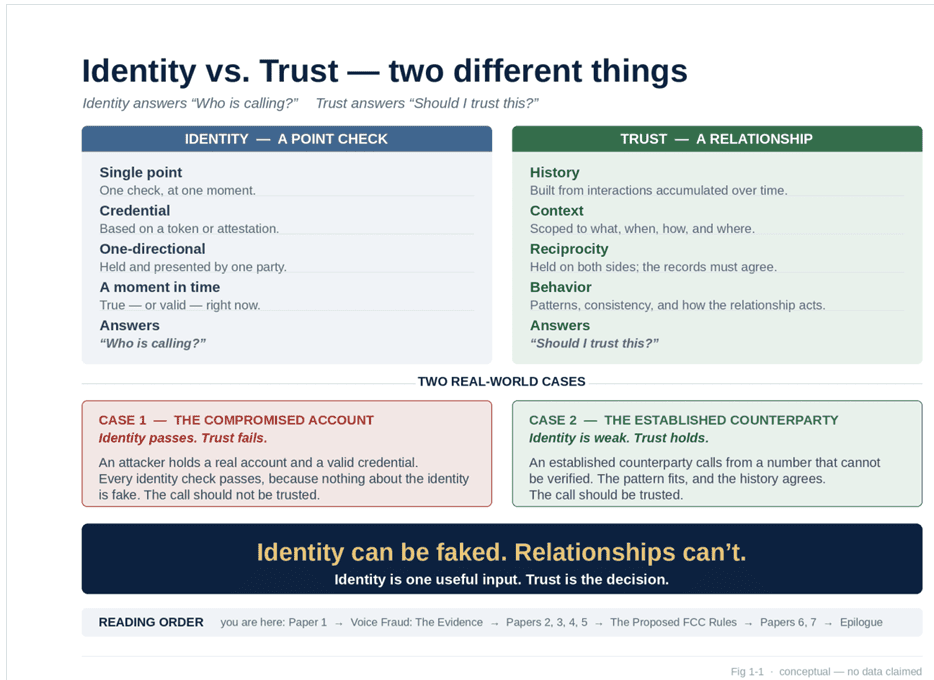
Trust is a relationship, not an attribute. It is not a stamp a party carries; it is a state that exists between two parties, and it is built from evidence that accumulates over time. Consider how you actually trust the people you trust. You trust your sister’s voice on the phone not because a credential — an authenticated caller ID — verified it, but because you have heard it your entire life — its cadence, its turns of phrase, the things it would and would not say. Strip the history away and the credential alone would not be enough; keep the history and you can often recognize a caller before they have finished a sentence.
Three properties fall out of this that identity verification does not have:
- Trust is historical. It is a function of accumulated interaction. A relationship with a thousand prior exchanges is a different object than a first contact, even when the identity is equally certain in both. The relationship history is not an outgrowth of the trust; the trust is an outgrowth of the relationship history.
- Trust is contextual. The same verified party is trusted for some things and not others, at some times and not others, through some channels and not others. Trust is scoped to a relationship’s established pattern, not granted wholesale, and a request that falls outside that pattern draws suspicion even from a party you know well.
- Trust is reciprocal. It lives on both sides. Each party holds its own record of the other, and those records have to agree. That two-sidedness is very hard to fabricate, precisely because it does not live in one place where a single forgery can reach it. None of these properties can be read off a credential. They are properties of a relationship over time, and a point-in-time check has no access to any of them.
The call from your bank
A concrete example shows how much work the relationship is quietly doing. Your bank’s fraud line calls. You trust the call partly because of the number it comes from — but far more because of everything the number, by itself, cannot tell you. The caller references a transaction you actually made. The exchange unfolds the way these exchanges always have. It comes at a time of day your bank actually calls. You know how this bank handles these calls as surely as it knows you — the details it raises, the rhythm the two of you have settled into over years of dealing with each other. Nothing in the request falls outside the pattern of every prior interaction you have had with them. The credential is one input among many, and not the decisive one; strip it away and the rest — the familiar pattern, the shared history, the fit with how your bank actually behaves — would still mostly carry the call.
Now change one thing: the caller asks you to move money to a new account, urgently, in a way your bank never has. The number still checks out. The identity is still verified. And your trust evaporates — not because the credential failed, but because the behavior left the relationship’s established pattern. That single swing, from trust to suspicion with the credential held constant, is the whole argument of this paper in miniature. What moved was never the identity. It was the fit between the behavior and the relationship, which is the thing you were actually trusting all along.
What identity verification actually does
Identity verification answers exactly one question, and answers it well: who is the party presenting this communication? That is a genuinely valuable thing to know. Knowing origin deters casual abuse, raises the cost of the mass spoofing operations behind most robocalls, and makes calls traceable enough to hold the provider responsible. It would be a mistake to dismiss it, and this series does not. But notice the shape of what it provides. Identity verification is a point-check: it evaluates a claim at a moment, returns a yes or no, and says nothing about the relationship, the context, or the history in which the communication sits. It is issued to a party, not built between parties. It is one-directional — a credential the caller carries, not a record the callee also holds. And once granted, it does not change with behavior: the same verification rides the first call and the thousandth, the honest call and the abusive one. These are not defects. They are the boundaries of what a point-check is. Identity verification tells you who. It does not, and cannot, tell you whether to trust.
Where the two come apart
The clearest place to see the gap is the case the industry finds most uncomfortable: a valid credential on a compromised account. When a real account is taken over, every identity check still passes. The credential is real. The verification is honest. And the communication should not be trusted at all — because the relationship it claims to belong to is not the one actually driving it. That single case is enough to establish the point. Identity verified, trust misplaced. If verifying identity were the same as establishing trust, that situation could not exist. It exists routinely, and it is the case a purely identity-based system is structurally unable to see.
The reverse gap is just as real, and just as instructive. You can trust a communication whose formal identity you never verified, because everything else — the timing, the knowledge, the pattern, the reciprocal record on your side — lines up with a relationship you already have. Humans have always done this, and are usually right to. The identity check is one input to a trust decision, sometimes a helpful one; it is not the decision itself. Both gaps point the same way: identity and the trust decision are different objects, and they come apart in exactly the cases that matter most for fraud. None of this implies that relationships are infallible — people routinely misplace trust. The question is whether a relationship carries information a credential alone cannot.
Why this matters for voice
If identity and trust were interchangeable, the current direction of travel would be sound: verify harder, verify more, and trust follows. But because they are different things, an uncomfortable consequence follows. A system that verifies identity — however rigorously — has not yet made a trust decision. It has answered who. The question of whether still sits untouched, waiting for exactly the historical, contextual, reciprocal evidence a point-check was never built to carry. This matters more now, not less. Verifying a credential keeps getting cheaper and easier — and so does faking one. AI can now produce a convincing voice or face on demand. So the industry is leaning harder on identity at exactly the moment identity is becoming easier to counterfeit.
This is not an argument that identity verification should be abandoned. It is an argument that it should be seen for what it is: a useful input to a larger decision, not a substitute for it. The rest of this series follows that thread — what a trust decision actually requires, where identity helps and where it cannot reach, and what it would mean to build on the thing trust is actually made of, the relationship, rather than on the narrower thing we have been treating as its stand-in.
What this changes
Naming the distinction changes where the effort should go. If trust is relational and identity is a point-check, then pouring more attestation, more regulation, more verification into a stronger point-check improves the part of the problem that was already best handled and leaves the harder part — the relationship, the context, the behavior over time — exactly where it was. The productive move is not to abandon the credential but to stop asking it to be the whole decision, and to build the layer that can actually weigh whether a communication fits the relationship it claims. That is the argument the series develops. This paper asks only that one premise be granted: identity and trust are not the same thing.
What this series claims, and what it does not
A note on posture, because it governs everything that follows. This series is written to be read by people who know this domain well, including those inclined to disagree. So it holds to a discipline: it concedes what is true, claims only what it can defend, and marks the genuinely unsettled as unsettled. It does not argue that caller authentication has failed — it has measurably reduced certain kinds of abuse. It does not argue that identity does not matter. It argues something narrower and harder to refute: that a verified identity is useful, but not necessary and not sufficient for trust, because trust exists between two parties, while identity belongs to only one. Everything downstream — the evidence, the economics, the architecture, and the honest limits — rests on this one distinction. Get it right and the rest of the series follows. Blur it, and the entire debate about trust in communications is being conducted about the wrong thing.
About this series
Trust in Communications is a seven-part white-paper series, with two companion volumes and a concluding epilogue, examining one question: whether verifying identity is enough to establish trust in voice communications.The list below is in reading order — the companions sit where they are best read, not at the end.
- What Trust Actually Is (this paper)
◇ Companion — Voice Fraud: The Evidence - The Role of Caller Authentication in Establishing Trust
- The One Layer That Can Stand Alone
- The Permanent Coverage Gap
- Even If the Proposed FCC Rules Work Perfectly, Will They Be Enough?
◇ Companion — The Proposed FCC Rules - Why a Relationship Cannot Be Faked at Scale
- The Compromised Account
◆ Epilogue — What Changed, What Remains True
Read the full series at ICATrusted.ai.
Drafted with AI assistance; all analysis, claims, and conclusions rest with the series editor.