03 Trust in Communications, Paper 2: The Role of Caller Authentication in Establishing Trust

The Role of Caller Authentication in Establishing Trust
Useful, but Not Necessary
TRUST IN COMMUNICATIONS · PAPER 2 OF 7 · ICA AI, Inc. · +Trusted Infrastructure · July 2026
A +Trusted Infrastructure series from ICA AI
Series editor: John Perkins, Chief Executive Officer
Caller authentication earns a real place in a trust decision. At the moment two parties share no history, an attestation signal is often the most useful thing available. But useful is not the same as required. Attestation is a fixed credential that does not change as a relationship does; the relationship signal is designed to update with every interaction. The credential is frozen; the relationship learns. A single relationship, followed from its first call to its hundredth, draws the line the series turns on: authentication is useful, and most useful at the beginning, but it is not necessary, because the thing that ultimately carries trust is the relationship, not the identity credential.
What authentication genuinely provides
At genuine cold start — the first contact between two parties with no shared record — a caller authentication signal is often the best thing a receiving system has to go on. In the United States that signal is STIR/SHAKEN, the framework that attaches a cryptographic attestation to a call as it enters the network; where this series says the standard, that is the standard it means. It arrives before the call connects: it is a pre-ring signal, present at the exact moment when nothing behavioral yet exists. Remove it at that moment and you are left with less at the decision point, not more. So the honest starting position is not that authentication is weak or that the last decade of work on it was misdirected. It is that authentication is valuable, and most valuable precisely when a relationship is youngest and there is nothing else to weigh.
A pharmacy the customer has never used calls for the first time about a transferred prescription. There is no history to draw on, no pattern to match, no reciprocal record on either side. In that moment a validly attested number is a genuine signal — a caller cannot produce one just by spoofing a number for free — and it gives the receiving side something real to weigh where it would otherwise have nothing. The argument that follows is not that the signal is useless. It is that the signal is temporary, and that its value is highest at exactly the point the relationship is weakest.
What the same evidence base also shows is where that value stops. The top attestation grade is routinely carried by prolific robocallers — among the ten most prolific robocall-signing providers, 97.4 percent of calls arrive at A-level, the highest grade the framework issues — because the grade certifies how a call got onto the network — which provider originated it and vouched for the number — not whether the call is worth trusting. And attestation and voice authenticity are independent — neither tells you anything about the other: a correctly signed, top-grade call can carry a cloned voice, because the credential vouches for a number’s provenance, not for who is actually speaking. The signal that is genuinely useful at cold start is, demonstrably, not a trust decision on its own.
Frozen by design
The defining property of a credential is that it does not change with behavior. The attestation on call one is the attestation on call one thousand; the honest call and the abusive one carry the same grade. This is not a defect — it is what a credential is, and what makes it verifiable at all. But it has a consequence that is easy to miss. Authentication says exactly the same thing about a specific pair of parties on their first interaction and their hundredth. It cannot grow more accurate about that pair over time, because it was never built to observe the pair. It authenticates a party in isolation, once, and issues the same verdict forever — which is precisely why it is strongest when there is no history to be more accurate about, and why its relative value falls as history accumulates around it.
The signal that learns
A relationship signal is defined by the opposite property: it changes. The relationship layer is designed to update its picture of a specific pair with every genuine interaction — timing, cadence, the knowledge exchanged, the reciprocal record each side holds – so that the signal available at the hundredth call is richer than the one available at the first.
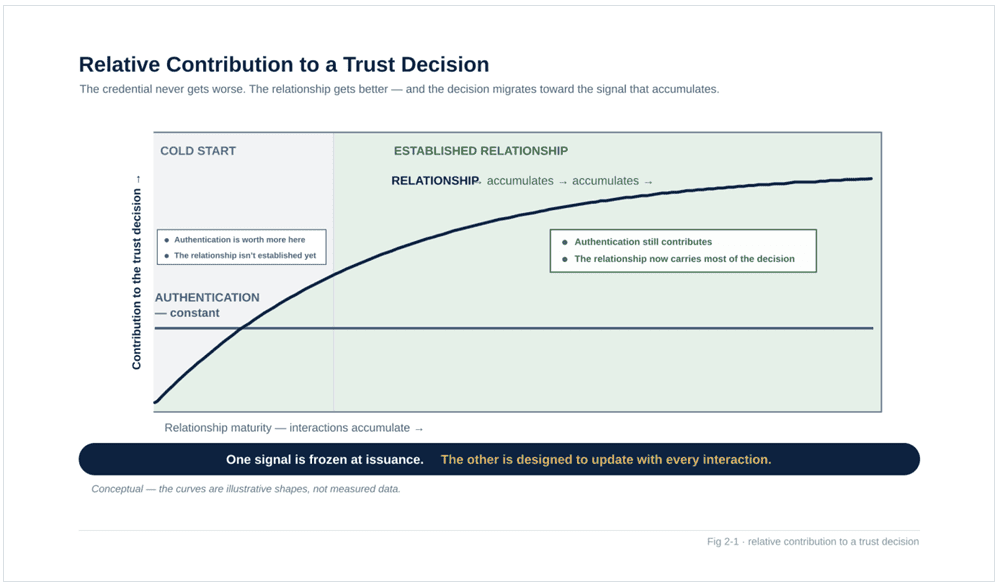
The credential is worth the same on the hundredth call as on the first; the relationship signal is designed to update with every interaction.
Conceptual — the axes carry no scale.
A fair objection: number-reputation systems already learn over time, which makes the word frozen sound too strong. The answer is what each system learns about. Reputation systems learn about a number — a single party in isolation — building a score that is still issued to that party and carried by it wherever it goes. The relationship signal learns about a pair of parties: not how a number behaves in general, but whether this particular communication fits the history these two specific parties share. A number can carry a spotless reputation into a relationship it has no business being in, and a number-level system will wave it through; the pair-level signal is the thing built to notice. That is the asymmetry that matters — not whether a system learns, but whether it learns about a party or about a relationship.
There is a second distinction the industry tends to blur, and it is load-bearing too. Attestation is a pre-ring signal, present before the call connects. The recipient’s own decision to block, screen, or trust is post-ring feedback, available only afterward. They are not substitutes. At true cold start there is no post-ring history yet — which is exactly why authentication is most valuable there. As
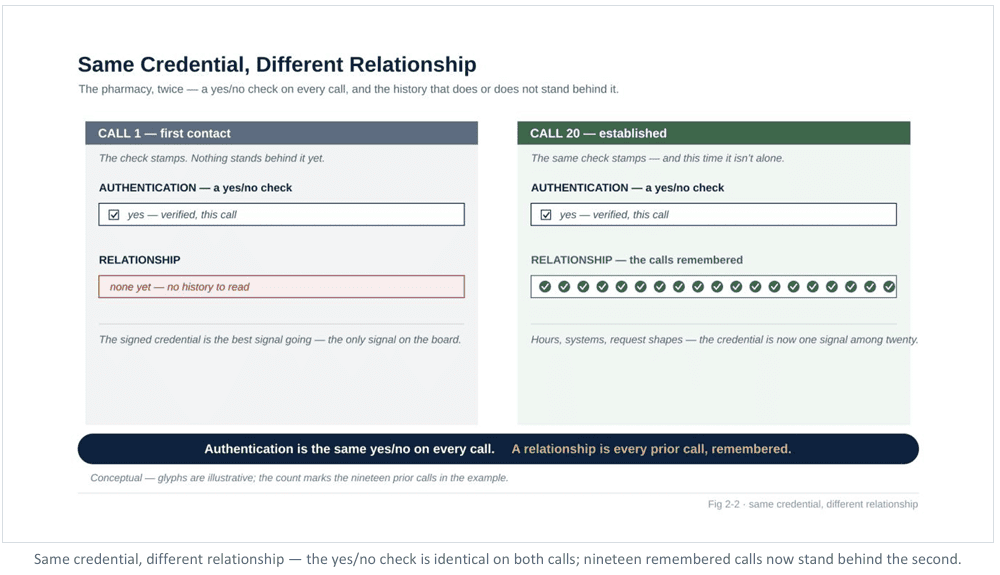
interactions accumulate, the behavioral record grows and the frozen pre-ring credential becomes a smaller share of what the decision actually rests on. Return to the pharmacy. By the twentieth genuine call, the receiving side has a texture to match against — the hours it calls, the systems it references, the way its requests are shaped — and the attestation that carried the first call is now one small input among many. The credential did not get worse. The relationship simply got better, and the decision migrated toward it.
What “supersede” means — and what it does not
As a relationship matures, the behavioral signal is designed to outweigh the credential in the trust score. That is a precise claim, and worth stating precisely, because it is easy to overstate into something this series does not mean. Supersede does not mean discard. Consider a top-grade call —validly signed, highest attestation — that the recipient blocks because everything about it is wrong. That event should lower trust for that pair and teach the graph, even though the credential was real and correctly issued. The credential remains an input; it simply stops being the deciding input once there is an established relationship to weigh it against. How the engine weights these inputs against one another over time is a matter of implementation; the structural point does not depend on it. So is where the layer runs: whether the relationship signal is computed by a carrier, an endpoint, or another trusted system is outside the scope of this paper. One signal is frozen and one learns, and over a relationship’s life the one that learns comes to carry more of the weight.
Scaffolding, not floor
The accurate picture, then, is that authentication is scaffolding. It is most load-bearing when the structure is new and carries less as the structure sets — seemingly necessary at the start, superseded as the relationship signal matures. Scaffolding is not a criticism; you cannot raise the building without it, and pretending otherwise would be its own kind of overclaim. But no one confuses the scaffolding with the wall. This is also the honest answer to the strongest objection: that you cannot build trust on an unauthenticated network. At cold start that is true — where there is no history, authentication is the best signal going. What is not true is that this holds forever. The claim is not that authentication is dispensable in general; it is that it is temporary in any given relationship — the support a relationship needs most at the start, and less and less as it grows able to stand on its own.
What this changes in practice
If authentication is scaffolding rather than floor, the practical consequence is about where to invest. The instinct of the last decade — and of the proposed rules being written now — has been to make the credential stronger: harder to forge, more widely mandated, more finely graded. That work has value, and this paper does not argue against it. But it runs into a ceiling the later papers document, because a stronger credential still says the same thing about the thousandth call as the first. The layer with more headroom is the one that improves with every interaction: the relationship. Investing there does not mean abandoning authentication; it means recognizing which layer is scaffolding and which is structure, and putting the weight on the part that is designed to keep getting better after the credential has said all it can say.
There is a second consequence, easy to overlook. Because authentication is most valuable at cold start and least valuable once a relationship matures, its value is concentrated in a shrinking share of interactions over time. Every relationship that establishes itself is one more relationship for which the credential has become a minor input — while the credential’s cost, in mandates and infrastructure and grading rigor, is paid on every call regardless. The economics of the two layers run in opposite directions: authentication continues to require the same infrastructure investment even as it contributes less with accumulating history, while the relationship signal costs its effort up front and contributes more as history accumulates. A trust system that understands this does not choose between them; it leans on authentication exactly where it is strong, at the beginning, and lets the relationship carry the growing remainder — which is most of the interactions, most of the time.
About this series
Trust in Communications is a seven-part white-paper series, with two companion volumes and a concluding epilogue, examining one question: whether verifying identity is enough to establish trust in voice communications. The list below is in reading order — the companions sit where they are best read, not at the end.
- What Trust Actually Is
◇ Companion — Voice Fraud: The Evidence - The Role of Caller Authentication in Establishing Trust (this paper)
- The One Layer That Can Stand Alone
- The Permanent Coverage Gap
- Even If the Proposed FCC Rules Work Perfectly, Will They Be Enough?
◇ Companion — The Proposed FCC Rules - Why a Relationship Cannot Be Faked at Scale
- The Compromised Account
◆ Epilogue — What Changed, What Remains True
Read the full series at ICATrusted.ai.
Drafted with AI assistance; all analysis, claims, and conclusions rest with the series editor.