
04 Trust in Communications, Paper 3: The One Layer That Can Stand Alone

The One Layer That Can Stand Alone
What Communication Trust Actually Rests On
TRUST IN COMMUNICATIONS · PAPER 3 OF 7 · ICA AI, Inc. · +Trusted Infrastructure · July 2026
A +Trusted Infrastructure series from ICA AI
Series editor: John Perkins, Chief Executive Officer
Remove caller authentication from the picture entirely and ask a blunt question: can a trust decision still be made another way? This paper argues it can — that the relationship layer is the one layer able to stand alone, while the identity layer, however well verified, cannot render a trust decision by itself. That makes authentication an input that looks load-bearing but is ultimately optional, and makes the relationship the thing trust actually rests on.
A cautionary case: false certainty is worse than none
In 2002 Arthur Andersen, one of the most trusted names in auditing, collapsed within months. What destroyed the firm was not that its certifications were missing — they were present, signed, and authoritative. They were simply wrong — and they were acted upon precisely because they looked authoritative. A missing signal makes people check. A confident, valid-looking signal makes people act — no one re-verifies what looks certified. That is how Andersen’s wrong certifications did their damage. Auditing is not telecommunications, and the analogy claims no more than one shared structural property: a signal acted on because it looks authoritative, regardless of what stands behind it. The lesson for any trust system is uncomfortable: a certification that is trusted because it looks authoritative is more dangerous, not less, when it is wrong. Any architecture that treats a valid identity credential as the trust decision inherits exactly that failure mode — it converts a checkable claim into an unquestioned one. A stolen credential passes that check perfectly, and the system reports its highest confidence at exactly the moment it is most wrong.
The load-bearing test
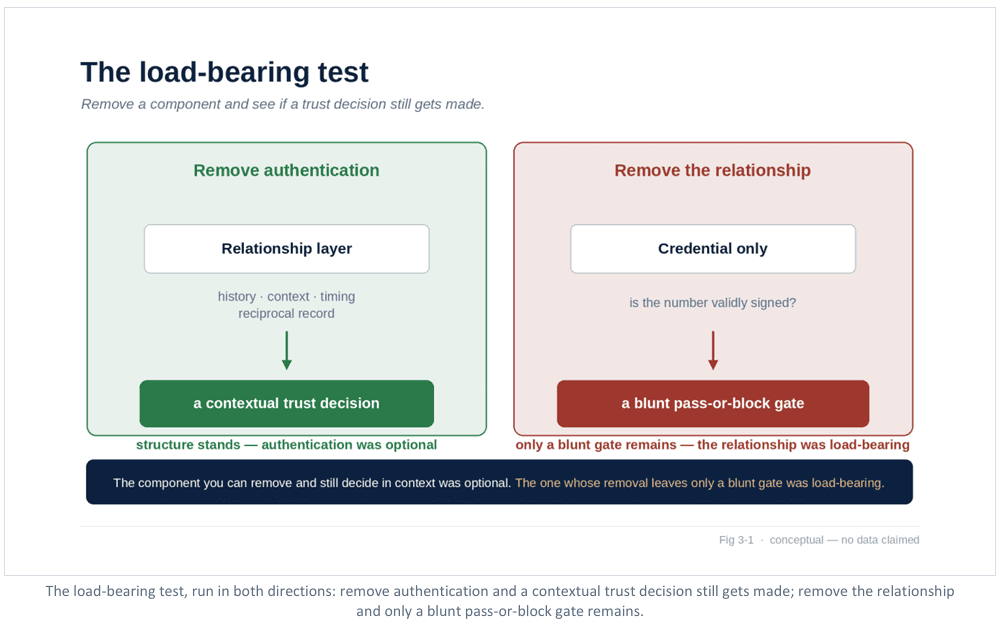
There is a simple structural test for whether a component is load-bearing or optional, borrowed from the way engineers talk about buildings: remove it and see if the structure still stands. Apply it to caller authentication. Remove authentication and a relationship-based trust decision can still be rendered — from history, context, timing, the knowledge two parties share, and the reciprocal record each holds of the other. The decision is weaker at cold start — the very first contact, before any history exists — and this paper will not pretend otherwise, but it is still a decision, and it is still made on evidence.
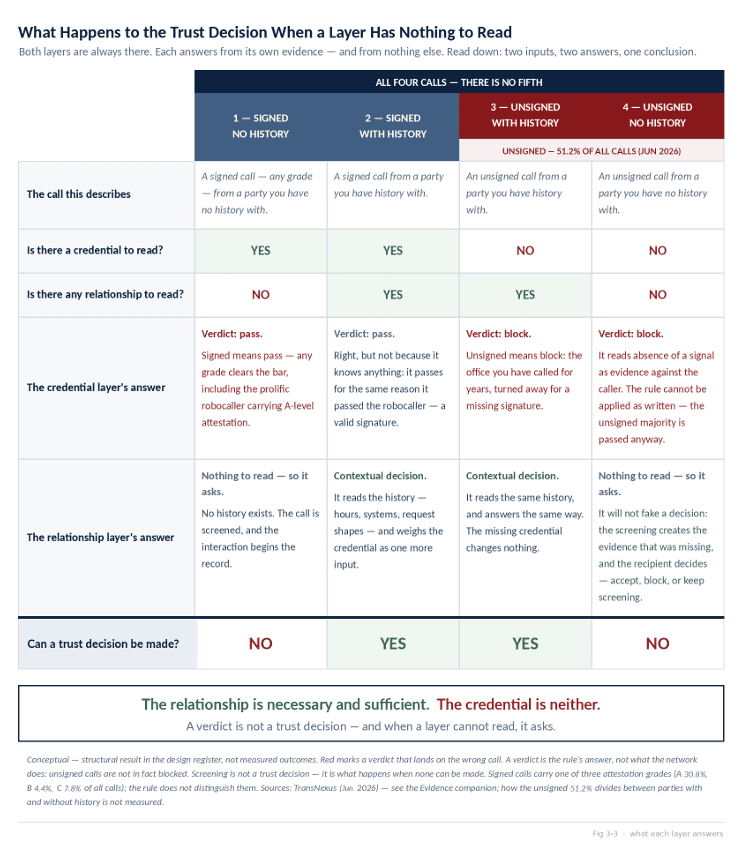
Now run the test the other way, because a test you only run in one direction proves nothing. Remove the relationship and keep only the credential, and what remains is a decision of the bluntest kind — binary: pass anything validly signed, block anything unsigned. That is a real decision — identity does decide something. But look at what it decides. Roughly 49% of calls arrive signed and 51% arrive unsigned (June 2026). Applied literally, the credential-only gate blocks half of all calls, the overwhelming share of them legitimate. No carrier does that, which is the tell: the unsigned majority is passed anyway, and a rule that cannot be applied as written cannot be the trust decision. Even where it is applied, what it produces is a blunt, static gate rather than a judgment about whether this particular communication, in this particular context, should be trusted. It cannot tell a first-time caller from a thousandth, a routine request from an anomalous one, or an established account from a compromised one carrying the same valid credential. So the asymmetry the test exposes is not that identity decides nothing. It is that identity can only make a blunt decision, while the relationship layer can decide in context. Remove authentication and a contextual decision still gets made — so authentication was optional. Remove the relationship and all that remains is the blunt gate — so the relationship was load-bearing all along.
Why a credential cannot stand alone: an example
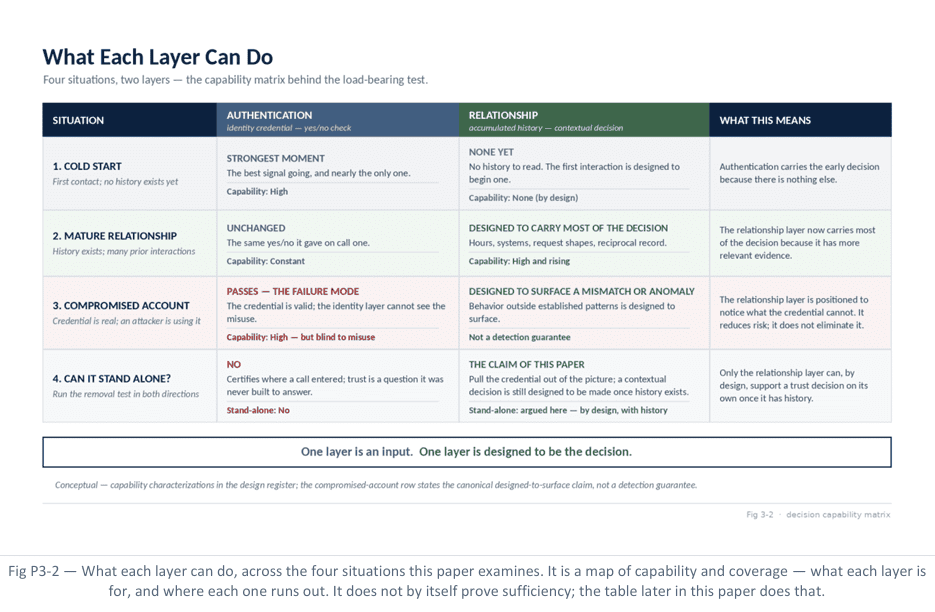
Consider the compromised account. A customer has banked with an institution for many years. The fraud line calls occasionally — always from the same number range, always in business hours, always referencing activity the customer can recognize, never asking for a full credential over the phone. That is the relationship, and both sides hold a version of it. Now suppose the account is taken over and the attacker places a call. Every identity check passes, because nothing about the identity is forged. From the point of view of a pure authentication layer, this call is indistinguishable from the years of genuine ones that came before it — same verified party, same green light.
The relationship layer is positioned to notice what the credential cannot. The credential is valid and the behavior is wrong: a contact at an hour this relationship never uses, a request the real party would never make, a pattern that does not match the reciprocal record the counterparty holds. Identity verification cannot tell that the account has been taken over — it authenticates the credential, not the behavior, so it has no mechanism to catch a real credential being used wrongly. A relationship layer is not blind in the same way, because it is designed to check whether a communication matches the authorized relationship context and the relationship record; a valid credential acting outside established patterns is designed to surface as a mismatch or anomaly, and the credential alone never confers trust. Overstate the claim, though, and it would repeat the Andersen error in the other direction. The relationship layer is not impossible to trick. It can be tricked, and two later papers in this series are about precisely that. The defensible claim is narrower and holds: the relationship layer is harder to trick, and when it is tricked, it fails less completely — because it watches behavior over time rather than checking a badge once.
Only the relationship can decide alone
Rank the layers on the axis that actually decides the question, which is not importance or order but sufficiency — whether a layer can render a trust decision by itself. Call it the standalone test. It is worth naming what a trust decision is, since everything turns on it. A trust decision is not the same as a disposition: any system can dispose of a call — pass it, block it, ring it through. A trust decision is a judgment about whether this communication fits this relationship, and it cannot be made without evidence about the pair. That is why the credential can be the most valuable input available at first contact, as the previous paper argued, and still not produce one. On that axis the relationship layer is the one layer that passes: it can render a decision without the others, while identity cannot decide without the relationship.
It is worth being precise about what “cannot decide” means, because identity does render a verdict — it simply renders the wrong one where it counts. Among the ten most prolific robocall-signing providers, 97.4% of calls carry A-level attestation, the top grade the framework can issue. The credential is not silent on that traffic and it is not uncertain about it: it certifies, correctly and at the highest grade, the very calls the system exists to stop. The certification is accurate. Treating it as a trust decision is the error. A layer that renders its highest verdict on the worst traffic is not deciding badly. It is answering a different question and having its answer mistaken for a decision. Two properties drive the result. The relationship signal is dynamic, multidimensional, and self-updating, where the credential is static and binary. And the relationship signal is designed to become sufficient once mature — not merely to add confidence at the margin, but to carry the entire decision. The relationship layer leans on identity early and ends superior to it: at cold start the credential is the better signal — the relationship has nothing yet to read; once the relationship is established, it is designed to outweigh the credential and to stand without it. That is a ranking on sufficiency, not a claim about position in a stack, and where it has not yet been proven at production scale it is stated as a design intention rather than an accomplished fact.
That is the conclusion. The rest of this paper asks whether it survives the strongest objections to it: the incentives of the layer being asked to bear the decision, the coverage a perfect credential still cannot reach, and the moment before any relationship exists.
Why the identity layer’s incentives are backwards
There is a structural reason not to rest the whole trust decision on the identity layer, and the strongest version of it does not come from us — it comes from the government’s own description of the market. Originating providers, the parties who attest to a call’s identity at the source, are compensated on the volume of calls they carry, not on the integrity of those calls. The party the industry is asking to vouch for a call is paid to move calls, and paid the same whether the call is honest or dishonest. That is a built-in conflict of interest at exactly the layer being asked to bear the trust decision. It does not make attestation worthless; it means the incentive to attest accurately is structurally weaker than the incentive to attest at all. And the evidence is exactly what that incentive predicts: as the standalone test already showed, the top attestation grade is routinely held by prolific robocallers. The grade is not failing — it certifies where a call entered the network, and it does that accurately. Whether the call should be trusted is a question it was never built to answer. A layer with that incentive structure can be a useful input. It is a poor candidate to be the whole decision.
Perfect authentication still leaves a gap
Grant every other layer its strongest possible form — STIR/SHAKEN attestation signed and surviving end to end, branded caller ID, flawless know-your-customer, no laundering in transit. An independent relationship layer still covers something none of them touch: whether a verified party is behaving consistently with the relationship it claims. That is a gap the others do not close on their best day, because it is not the question they are built to answer. Adding a layer that closes it is therefore additive in coverage. And the gap is not small. It is exactly where the compromised account lives: valid credentials, genuine identity, wrong behavior — a case authentication cannot touch, however perfect. The size of that share is the subject of a later paper in this series; what matters here is that no amount of authentication, however perfect, can shrink it.
Additive does not mean free. Any additional decision layer can produce false positives: a genuine call slowed or challenged because the pattern looked briefly wrong. That cost is real and has to be managed; a serious deployment is judged partly on how low it keeps the false-positive rate. But it is a tuning problem, not a structural objection: the layer can be tuned toward caution or toward permissiveness, while the gap it closes cannot be reached by hardening anything else at all. So the real question is never whether the relationship layer is perfect — it is whether the coverage it uniquely provides is worth the operational load it adds. For a gap nothing else reaches, it generally is. A defense-in-depth layer whose one real cost is false positives it can be tuned to minimize is difficult to argue against on the merits — which is why this frame, and not any ranking, is the one that holds even for a reader who concedes nothing else.
The cold-start objection, answered
The strongest objection to all of this is cold start: if the relationship layer needs history, what does it do on the very first interaction, before any history exists? Three answers, and they compound. First, cold start is exactly where authentication is most valuable, as the previous paper argued — the layers are complementary, strongest at different moments, not rivals for the same one. Second, at carrier scale the relationship graph does not launch empty. Anchor history already held in the network can be backfilled, so the graph is designed to launch with meaningful breadth rather than starting cold for every pair. That backfill is breadth, not longitudinal depth: it does not manufacture years of history where none exists. What it does is narrow the cold-start gap in practice, so the window in which the relationship layer has little to say is smaller and rarer than the objection assumes. Third, even a truly unknown first contact does not force a blind decision. The interaction can be screened rather than simply allowed or refused — a few questions put to the caller, the exchange visible to the recipient, and the recipient’s own decision to block, screen, or trust becomes the first entry in the relationship record. The very first interaction is designed to produce relationship evidence, not merely to happen without it. Even with no authentication layer at all, that disposition still gets made — and, on the definition above, a trust decision is not yet possible, which is precisely why the interaction is screened rather than guessed at.
What this changes in practice
If the load-bearing layer is the relationship rather than the credential, the right place to invest is not another increment of authentication hardening — which, as the coverage and enforcement papers show, runs into structural limits — but the layer that can render a contextual decision and improve with every interaction. It reframes what a trust system is for: not proving who is on the line, which the AI era has made cheaper to fake and cheaper to verify, but deciding whether this communication fits the relationship it claims. That is a different question, aimed at a different target, and it is the question the papers that follow are built to answer. Standing alone is a stronger claim than eventually outweighing, and this paper treats it accordingly: the structural case is made here; the evidentiary weight rests on the papers and the production record still to come.
House on sand
One objection remains: that a relationship layer built above an unauthenticated network is a house on sand. But run the removal test again: take authentication away, and the relationship layer still decides. A house does not stand when its footings are pulled. The relationship layer does not rest on the credential the way a house rests on its footings; it uses the credential when useful and stands without it when necessary. Optional input, load-bearing layer — the credential can be pulled and the decision still gets made, which is the entire definition of optional. That is why the remaining papers can set the relationship layer aside for stretches and still find the identity approach coming up short on its own terms: short on coverage, where fraud routes around the hardening, and short on enforcement, where even a flawless rule arrives after the call it was meant to stop is already over. The credential matters most at the first hello and matters less with every interaction after it; the relationship is designed to carry the decision alone long before anyone thinks to pull the credential away.
About this series
Trust in Communications is a seven-part white-paper series, with two companion volumes and a concluding epilogue, examining one question: whether verifying identity is enough to establish trust in voice communications. The list below is in reading order — the companions sit where they are best read, not at the end.
- What Trust Actually Is
◇ Companion — Voice Fraud: The Evidence - The Role of Caller Authentication in Establishing Trust
- The One Layer That Can Stand Alone (this paper)
- The Permanent Coverage Gap
- Even If the Proposed FCC Rules Work Perfectly, Will They Be Enough?
◇ Companion — The Proposed FCC Rules - Why a Relationship Cannot Be Faked at Scale
- The Compromised Account
◆ Epilogue — What Changed, What Remains True
Read the full series at ICATrusted.ai.
Drafted with AI assistance; all analysis, claims, and conclusions rest with the series editor.